Loading Dock Maintenance Checklist: Free PDF, Excel and Inspection Log
- Author:
- Greenville Dock Door Repair Research
- Version:
- 1.0
- First published:
- Last verified:
| Attribute | Value |
|---|---|
| Total operational rows | 82 (LD-001 through LD-082) |
| Program controls | 8 (PC-01 through PC-08) |
| Pre-use layer | 22 rows |
| Facility-audit layer | 28 rows |
| Technician-PM layer | 32 rows |
| Construction sources | 13 |
| Supplementary OSHA sources | 2 |
| Public file formats | PDF, Excel workbook, CSV, JSON manifest |
| Version | 1.0 |
| First published | July 22, 2026 |
| Last verified | July 21, 2026 |
| Correction policy | Substantive changes require versioned record and updated checksums |
Source: Evidence-Mapped Loading Dock Maintenance Matrix, Version 1.0; row counts LD-001 through LD-082 and PC-01 through PC-08.
Free Downloads — Version 1.0
All files are regenerated from the same release tables as this page. Checksums are provided in the JSON manifest.
The workbook includes filterable tables, deficiency tracking fields, and editable frequency columns. The PDF is a print-ready version of the same data.
How to Cite This Page
The reference block below provides the page title, publisher, version and verification date in a neutral format. For a specific data row, use its stable Check ID and the source code shown in that row.
Greenville Dock Door Repair Research. “Loading Dock Maintenance Checklist: Free PDF, Excel and Inspection Log.” Version 1.0. First published July 22, 2026. Last verified July 21, 2026. https://greenvilledockdoorrepair.com/research/loading-dock-maintenance-checklist/For a specific data row, use its stable Check ID and fragment URL—for example, https://greenvilledockdoorrepair.com/research/loading-dock-maintenance-checklist/#LD-042—and include the row-level source code shown in the matrix.
Loading Dock Maintenance Checklist Data: What Do the 82 Checks Show?
The Version 1.0 row distribution shows that this checklist is organized primarily around role and evidence rather than one frequency. Fifty of 82 rows—61.0%—are pre-use or facility-condition observations, while Version 1.0 assigns 32 rows—39.0%—to the technician layer rather than to the operator-check layer.
Those figures make a practical boundary visible: operators and facility inspectors can identify many conditions, but internal, adjusted, structural, electrical, hydraulic, counterbalance and prescribed testing work belongs under the required procedure and role.
The figures do not show how often defects occur, how many loading-dock incidents happen, which manufacturer is safest or what percentage of facilities follow a practice. No incident survey, field inspection or market census was conducted. The counts describe the architecture of this published checklist and can be reproduced from LD-001 through LD-082.
| Inspection layer | Rows | Share of 82 | Primary purpose |
|---|---|---|---|
| Pre-use or operating-day | 22 | 26.8% | Find visible hazards and abnormal operation before use without turning an observation into a repair instruction. |
| Periodic facility-condition audit | 28 | 34.1% | Review the whole dock position, records and conditions that a quick operating check can miss. |
| Technician planned maintenance | 32 | 39.0% | Perform internal, adjusted, structural, electrical, hydraulic or prescribed service and testing under the controlling procedure. |
Source: Evidence-Mapped Loading Dock Maintenance Matrix, Version 1.0; row counts LD-001 through LD-082.
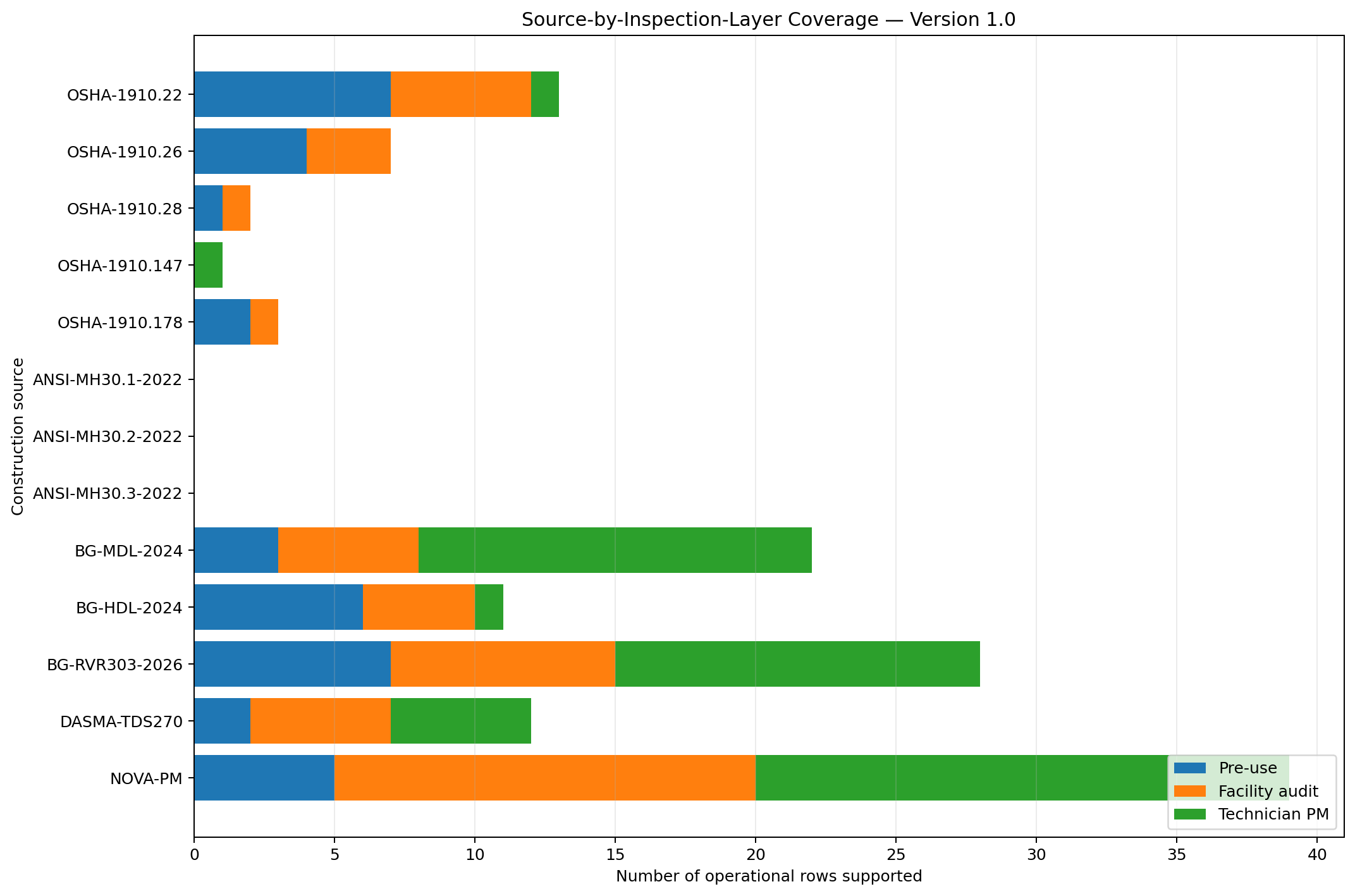
| Construction source | Pre-use rows | Facility-audit rows | Technician-PM rows | Total supported rows |
|---|---|---|---|---|
| [OSHA-1910.22] | 7 | 5 | 1 | 13 |
| [OSHA-1910.26] | 4 | 3 | 0 | 7 |
| [OSHA-1910.28] | 1 | 1 | 0 | 2 |
| [OSHA-1910.147] | 0 | 0 | 1 | 1 |
| [OSHA-1910.178] | 2 | 1 | 0 | 3 |
| [ANSI-MH30.1-2022] | 0 | 0 | 0 | 0 |
| [ANSI-MH30.2-2022] | 0 | 0 | 0 | 0 |
| [ANSI-MH30.3-2022] | 0 | 0 | 0 | 0 |
| [BG-MDL-2024] | 3 | 5 | 14 | 22 |
| [BG-HDL-2024] | 6 | 4 | 1 | 11 |
| [BG-RVR303-2026] | 7 | 8 | 13 | 28 |
| [DASMA-TDS270] | 2 | 5 | 5 | 12 |
| [NOVA-PM] | 5 | 15 | 19 | 39 |
Source: Calculated directly from the corrected Version 1.0 operational CSV. Multiple sources can support one row, so supported-row totals are not additive. The three ANSI listings show zero operational rows because they establish standards identity and scope in this release rather than supplying public row-level instructions.
How Was the 82-Point Loading Dock Maintenance Checklist Produced?
Version 1.0 was assembled through an AI-assisted editorial workflow from five federal OSHA provisions, three official ANSI/MHI listings, three manufacturer owner manuals, one DASMA technical data sheet and one manufacturer preventive-maintenance checklist. The source crosswalk and row-level verification process are described below.
Two supplementary official OSHA sources—OSHA-1910.21 and OSHA-STD-01-11-007—were added for the official dockboard definition and the positive-restraint enforcement interpretation. Those two sources are linked and disclosed separately from the original 13-source construction set.
Check every applicable requirement
- Applicable federal, state and local requirements, including official interpretations that affect how a rule is applied.
- The exact current manual for the installed make, model and revision.
- Applicable consensus standards and official listings used within their lawful scope.
- Employer procedures, manufacturer or technical-association guidance, and Version 1.0 editorial controls, each labeled for what it is.
Do not discard one applicable requirement merely because another appears stricter; resolve the legal, site and equipment-specific requirements together.
Row-inclusion rules
A proposed operational row was retained only when it did at least one of the following:
- translated an applicable primary-source duty into an observable condition or required record;
- preserved a manufacturer-defined inspection, maintenance, support or role boundary;
- normalized a component repeated across original equipment material;
- created a traceable record needed to connect a failed condition to correction and return to service.
Unsupported injury statistics, generic claim-cost figures, penalty amounts, copied standards text, product recommendations and numbers that could not be reproduced were excluded. A visible inspection point was not converted into an unauthorized repair instruction.
Source codes identify the primary document supporting the checkpoint, duty, component or role boundary. Unless a row quotes or identifies a source-specific limit, the acceptable-condition and failed-item-action fields are Version 1.0 editorial synthesis, not verbatim regulatory text or manufacturer acceptance criteria.
| Evidence class | Documents | Use in Version 1.0 |
|---|---|---|
| Federal regulation | 5 | Legal duties and scope-specific requirements used in the operational matrix. |
| Current official standards listing | 3 | Edition, title and standards context only; copyrighted text is not reproduced. |
| Manufacturer owner manual | 3 | Product-specific checks, intervals, role boundaries, supports and test sequences. |
| Industry technical data sheet | 1 | Rolling-door scope, visible checks, role boundaries, interval guidance and event triggers. |
| Manufacturer checklist | 1 | Component inventory and PM coverage; not a universal interval. |
| Construction-source total | 13 | Every operational row points to at least one construction source. |
| Supplementary official OSHA source | 2 | The official dockboard definition and positive-restraint enforcement interpretation. |
Source: Primary-Source Register, last verified July 21, 2026.
Reproducibility
The public operational CSV is the source of truth for LD-001 through LD-082. PC-01 through PC-08 are a separately identified program-control table within the same release. Every release regenerates the page tables, PDF, Excel workbook and checksum manifest from those two versioned tables.
A substantive row change requires a versioned change record, updated file hashes and a new dateModified. Cosmetic edits do not justify re-dating the dataset.
What Does This Loading Dock Maintenance Checklist Include?
The checklist treats a loading dock as one connected operating position rather than as a dock leveler alone. It covers walking surfaces, dockboards, levelers, trailer movement, vehicle restraints, communication signals, rolling doors, seals, shelters, bumpers, controls, corrective action and return-to-service records within the source boundaries stated below.
OSHA defines a dockboard as a portable or fixed device that spans a gap or compensates for a difference in elevation between a loading platform and a transport vehicle; dockboards include bridge plates, dock plates and dock levelers. A vehicle restraint is a device intended to help control trailer movement or separation during loading and unloading. A powered industrial truck (PIT) is OSHA’s term for covered industrial trucks such as forklifts.
Terminology source: [OSHA-1910.21], [OSHA-1910.26], [OSHA-1910.178], [ANSI-MH30.1-2022], [ANSI-MH30.2-2022], [ANSI-MH30.3-2022].
| Role term | Meaning in this page | Evidence boundary |
|---|---|---|
| Operator or facility inspector | Performs only the assigned visible or normal functional check. | A failed observation does not authorize diagnosis, adjustment or repair. |
| Authorized employee | Locks out or tags out machines or equipment in order to perform servicing or maintenance covered by the employer's energy-control program. | This is the §1910.147 lockout/tagout role. |
| Authorized technician | A person assigned and authorized for equipment work under the employer's procedures and the controlling equipment instructions. | This is an operational role used by Version 1.0, not a certification created by this page. |
| Qualified person | Has a recognized degree, certificate or professional standing, or extensive knowledge, training and experience demonstrating the ability to solve or resolve the relevant problem. | OSHA-1910.21 supplies the definition; OSHA-1910.22 expressly requires qualified performance or supervision when repair affects structural integrity. |
| Trained door systems technician | Performs rolling-door repairs, adjustments and technical evaluation under the door guidance and manufacturer instructions. | DASMA-TDS270 reserves counterbalance repairs and adjustments for this role. |
Source: [OSHA-1910.21], [OSHA-1910.22], [OSHA-1910.147] and [DASMA-TDS270].
In this page, authorized employee refers only to the §1910.147 lockout/tagout role. Authorized technician means a person assigned and authorized for equipment work under the employer’s procedures and the controlling equipment instructions; the two terms are not automatically interchangeable.
| Record | What it establishes | Why a checkbox alone is not enough |
|---|---|---|
| Asset register | Make, model, serial number, rated capacity where applicable, current manual and manual revision for each installed component. | A generic instruction cannot safely supply a model-specific interval, adjustment, lubricant, support method or acceptance limit. |
| Inspection log | What was observed, by whom, when, at which bay and under which checklist version. | A result without an asset, date and Check ID cannot be reconstructed. |
| Deficiency log | Condition, interim control, owner, due date, corrective work and closure evidence. | A failed box does not show whether the condition remained controlled. |
| PM record | Technician, source or manual revision, measurements, parts, adjustments, tests and release decision. | Maintenance is not complete until required tests and the return-to-service decision are recorded. |
Source: Evidence-Mapped Loading Dock Maintenance Matrix and Version 1.0 Program Control Framework.
What do Pass, Fail and N/A mean?
- Pass means the stated condition was observed for the scope of that check. It is not a certification that hidden components are defect-free.
- Fail means the stated condition was not met or could not be verified. Record the Check ID, observed condition, immediate control and person notified.
- N/A means the component is not installed or the row genuinely does not apply. It must not be used to avoid inspecting an installed system.
| Equipment or topic | Version 1.0 coverage |
|---|---|
| Walking-working surfaces | Covered through OSHA-1910.22. |
| Portable and fixed dockboards | Covered through OSHA-1910.21 and OSHA-1910.26, with MH30 listings used for standards identity and scope. |
| Mechanical and hydraulic dock levelers | Covered through the cited Blue Giant manuals and NOVA checklist. |
| RVR303-type vehicle restraint | Covered as a bounded manufacturer example through BG-RVR303-2026. |
| Rolling doors | Covered through DASMA-TDS270. |
| Dock seals, shelters and bumpers | Component-level coverage through cited manufacturer material. |
| Commercial sectional doors | Not comprehensively covered in Version 1.0. |
| High-performance doors | Not comprehensively covered in Version 1.0. |
| Rolling fire doors | Not comprehensively covered in Version 1.0. |
| State and local requirements | Not exhaustively compiled. |
Source: Version 1.0 source crosswalk. Door coverage is limited to the product type supported by DASMA-TDS270.
Version 1.0’s door rows cover rolling doors under DASMA TDS 270. Commercial sectional, high-performance and rolling-fire doors require separate type- and model-specific sources.
What Program Controls Should Exist Before a Checklist Is Used?
Version 1.0 adds eight program controls: an equipment register, current manuals, a justified cadence, role boundaries, energy and work-zone procedures, defect control, retained records and event-triggered review. In this framework, those controls sit above the 82 operational rows because they determine which instruction applies, who may act and whether a failed item stays controlled.
| ID | Program control | Evidence maintained in Version 1.0 | Version 1.0 target state | Source basis |
|---|---|---|---|---|
| PC-01 | Equipment register | Record each dock position's door, operator, leveler or dockboard, restraint, bumper and accessory make, model, serial number, rated capacity where applicable and current manual location. | The exact installed equipment can be identified without guessing. | [BG-MDL-2024], [BG-HDL-2024], [BG-RVR303-2026], [DASMA-TDS270] |
| PC-02 | Manual control | Keep the current owner, user and service instructions matched to each installed model and revision. | Operators and maintainers can retrieve the controlling instructions. | [BG-MDL-2024], [BG-HDL-2024], [BG-RVR303-2026], [DASMA-TDS270] |
| PC-03 | Inspection cadence | Document a site-specific schedule based on applicable requirements, the exact manual, operating cycles, environment, impacts, age and observed condition. | No interval is copied from an unrelated model or presented as a universal legal rule. | [OSHA-1910.22], [BG-MDL-2024], [BG-HDL-2024], [BG-RVR303-2026], [DASMA-TDS270] |
| PC-04 | Role boundaries | Assign operator observations, facility or EHS inspections, authorized maintenance, trained door-systems work, electrical work and qualified structural repair. | A failed observation does not become an unauthorized repair instruction. | [OSHA-1910.21], [OSHA-1910.22], [OSHA-1910.147], [DASMA-TDS270], [BG-MDL-2024], [BG-HDL-2024], [BG-RVR303-2026] |
| PC-05 | Energy and work-zone control | Maintain equipment-specific hazardous-energy, barricade and manufacturer-support procedures for covered servicing. | Authorized personnel can isolate applicable energy and physically support equipment before exposure. | [OSHA-1910.147], [BG-MDL-2024], [BG-HDL-2024], [BG-RVR303-2026] |
| PC-06 | Defect control | Define how failed checks are tagged, guarded, restricted, repaired, tested and authorized for return to service. | Known hazards cannot disappear between an inspection form and the next shift. | [OSHA-1910.22], [OSHA-STD-01-11-007], [BG-MDL-2024], [BG-HDL-2024], [BG-RVR303-2026] |
| PC-07 | Records | Retain inspection, PM, repair, parts, measurements, test results and return-to-service records by bay and asset. | A reviewer can reconstruct what was found, what changed and who released the equipment. | [BG-MDL-2024], [BG-HDL-2024], [BG-RVR303-2026], [NOVA-PM] |
| PC-08 | Event-triggered review | Define immediate review triggers after vehicle or forklift impact; high wind, flooding or seismic activity affecting a rolling door; or any condition in which dock equipment is structurally damaged, shows performance irregularities or may have been compromised. | Abnormal events can override the calendar schedule. | [DASMA-TDS270], [BG-MDL-2024], [BG-HDL-2024], [BG-RVR303-2026] |
Source: Version 1.0 Program Control Framework; each row’s source basis and evidence class are shown in the table.
What Should Be Checked Before Each Loading-Dock Use?
The pre-use layer contains 22 checks. It covers visible dock-area hazards, lighting and warnings, dockboard or leveler condition, trailer movement controls, restraint signals and normal rolling-door operation without authorizing an operator to enter a danger zone or perform repairs.
The cited mechanical leveler, hydraulic leveler and RVR303 manuals call for operator examination before any use: [BG-MDL-2024], [BG-HDL-2024] and [BG-RVR303-2026]. That product-specific language does not automatically make every row below a universal legal daily requirement; the current manual and site procedure still control the installed equipment.
| Pre-use evidence block | Rows |
|---|---|
| Area, access, lighting, warnings and dock-face condition | 8 |
| Dockboard, leveler, hydraulic and control checks | 8 |
| Trailer securement, restraint and communication | 3 |
| Rolling-door condition and movement | 2 |
| Inspection record and escalation | 1 |
| Total | 22 |
Source: Evidence-Mapped Loading Dock Maintenance Matrix, LD-001 through LD-022.
| ID | System | Checkpoint | Acceptable condition | Action if not acceptable | Responsible role | Source |
|---|---|---|---|---|---|---|
| LD-001 | Dock area and walking surfaces | Clear loose debris, packaging, pallets, straps and other trip or obstruction hazards from the dock approach, platform and travel path. | Travel paths are orderly and free of objects that could trip a person, catch equipment or block access. | Correct the condition before use or guard the affected path; record a deficiency if it cannot be corrected immediately. | Trained operator | [OSHA-1910.22], [BG-HDL-2024] |
| LD-002 | Dock area and walking surfaces | Check for spills, leaks, standing water, snow, ice or another slip hazard. | The surface is as clean and dry as feasible, and drainage or temporary controls are functioning where needed. | Clean, contain or guard the condition before normal use; escalate a continuing leak or drainage failure. | Trained operator | [OSHA-1910.22] |
| LD-003 | Dock area and walking surfaces | Confirm a safe, unobstructed route into and out of the dock position. | Employees can enter and leave without climbing over equipment or crossing a known hazard. | Restore safe access or restrict the route until the hazard is controlled. | Trained operator | [OSHA-1910.22] |
| LD-004 | Lighting and communication | Check the interior and exterior lighting needed to see the dock, trailer interface and controls. | The work area and equipment are visibly illuminated; no failed fixture prevents the assigned check or operation. | Do not continue an operation that cannot be seen adequately; report failed lighting or damaged fixtures. | Trained operator | [BG-HDL-2024], [BG-RVR303-2026] |
| LD-005 | Documentation and warnings | Verify that operating placards, exterior signs and critical caution or danger labels are present and legible. | Required instructions and warnings can be read from their intended positions. | Report and replace missing or illegible material under the current manufacturer documentation. | Trained operator | [BG-HDL-2024], [BG-RVR303-2026] |
| LD-006 | Dock edge and fall controls | Observe dock-edge markings and any installed gates, chains, rails or barriers for obvious damage or displacement. | Installed controls are visible, secured and positioned as intended; the site's fall-hazard evaluation remains applicable. | Guard or restrict the exposed area and obtain a site-specific evaluation before normal use. | Trained operator / supervisor | [OSHA-1910.28], [OSHA-1910.22] |
| LD-007 | Dock structure and bumpers | Look for new concrete cracking, loose curb angles, displaced steel, impact damage or deterioration around the pit and dock face. | No visible change suggests a loss of support, unstable attachment or new trip edge. | Restrict the affected area and obtain qualified structural evaluation when integrity may be involved. | Trained operator / supervisor | [OSHA-1910.22], [BG-HDL-2024] |
| LD-008 | Dock structure and bumpers | Check dock bumpers, risers and extensions for missing, loose, split or displaced components. | Components remain attached and positioned to protect the building and dock equipment during normal trailer contact. | Report the condition and restrict use when the defect could change trailer position or damage equipment. | Trained operator | [BG-HDL-2024], [BG-RVR303-2026] |
| LD-009 | Dockboard or dock leveler | Confirm that the dockboard or leveler is appropriate for the intended load and application. | The known rated capacity and configuration are suitable for the load, span and material-handling equipment. | Do not use when capacity or suitability is unknown; verify the asset record and current manual. | Operator / supervisor | [OSHA-1910.26] |
| LD-010 | Dockboard or dock leveler | Inspect the deck and lip for visible cracks, holes, severe corrosion, bending or warping. | Load-bearing surfaces appear intact, stable and free of damage that creates a trip or structural concern. | Stop or restrict use and obtain authorized evaluation when damage may affect safe operation. | Trained operator | [OSHA-1910.22], [NOVA-PM] |
| LD-011 | Dockboard or dock leveler | Remove debris from the lip, hinge line, pit edge and other exposed moving interfaces that can be reached without entering a danger zone. | No loose material visibly interferes with travel or creates a pinch or trip hazard. | Use the approved safe-cleaning method; do not reach into a pinch point or enter beneath equipment. | Trained operator | [BG-MDL-2024], [NOVA-PM] |
| LD-012 | Hydraulic or powered equipment | Look for visible hydraulic-oil leaks, damaged hoses or wet fittings around the leveler or restraint. | No active leak, abraded hose, loose fitting or pooled oil is visible. | Stop or restrict the affected equipment, contain the spill and refer diagnosis or repair to authorized personnel. | Trained operator | [BG-RVR303-2026], [NOVA-PM] |
| LD-013 | Electrical and controls | Check the control station, pendant, cords and enclosures for visible damage, looseness or missing covers. | Controls are secured, intact and dry, with no exposed conductor or open enclosure. | Do not open or repair electrical equipment; restrict use and notify authorized electrical or maintenance personnel. | Trained operator | [BG-RVR303-2026], [NOVA-PM] |
| LD-014 | Dockboard or dock leveler | Perform only the normal pre-use functional cycle allowed by the current manufacturer manual and site procedure. | The equipment completes its intended motion without binding, hesitation, abnormal noise, uncontrolled movement or a fault indication. | Stop the cycle when safe, prevent reuse and record the observed behavior for authorized evaluation. | Trained operator | [BG-MDL-2024], [BG-HDL-2024] |
| LD-015 | Portable dockboards and plates | Verify that the portable dockboard is anchored, secured or has sufficient contact where securing is demonstrably infeasible. | The device cannot move out of a safe position during the intended operation. | Reposition or secure it before use; do not drive over an unstable device. | Trained operator | [OSHA-1910.26] |
| LD-016 | Portable dockboards and plates | Confirm that handholds or another safe handling means are available and undamaged. | Employees can position the device using its intended handling feature without improvised lifting. | Remove the device from use until a safe handling means is restored. | Trained operator | [OSHA-1910.26] |
| LD-017 | Trailer or railcar securement | Confirm that the highway truck, trailer or railcar is prevented from moving while the dockboard is in use. | The applicable controls—such as brakes and wheel chocks, railcar wheel stops or other recognized positive protection, or a positive mechanical restraint installed, maintained and used to provide equivalent protection—are correctly applied under the site procedure. | Do not enter the vehicle until the required movement-control procedure is complete. | Dock operator / PIT operator | [OSHA-1910.26], [OSHA-1910.178], [OSHA-STD-01-11-007] |
| LD-018 | Vehicle restraint and chocks | Check that the installed restraint or required wheel chocks are present, undamaged and operational. | The restraint engages and releases as intended, or the chocks are correctly positioned and serviceable under the site procedure. | Keep the trailer entry closed to traffic until the required control is restored or an approved alternate procedure is applied. | Dock operator / supervisor | [OSHA-1910.178], [OSHA-STD-01-11-007], [BG-RVR303-2026] |
| LD-019 | Vehicle restraint and communication | Verify that inside and outside indicator lights, signs and audible warnings follow the intended operating sequence. | Signals are visible or audible and agree with the restraint's observable state under the manufacturer procedure. | Treat inconsistent signals as a failed control; prevent entry and escalate to authorized service personnel. | Dock operator | [BG-RVR303-2026], [NOVA-PM] |
| LD-020 | Rolling door | Observe the door through a normal cycle only when safe to do so, and confirm that it travels without binding and remains in its intended open position. | Movement is controlled, with no uncontrolled descent, severe noise, binding or failure to remain open. | Stop operation and keep people clear; refer abnormal movement to a trained door systems technician. | Trained operator | [DASMA-TDS270] |
| LD-021 | Rolling door | Visually check guides, curtain or grille rods, bottom bar and exposed fasteners for loose, bent, detached or hanging parts. | No component appears likely to fall, snag or interfere with door travel. | Restrict the opening and request trained door-system evaluation; do not adjust counterbalance components. | Trained operator | [DASMA-TDS270] |
| LD-022 | Records and escalation | Record every failed item with the dock or bay, asset identifier, immediate control and person notified. | The record is complete enough to trace the condition and prevent unnoticed reuse. | Create a deficiency ID and keep the restriction or interim control visible until authorized closure. | Operator / supervisor | [OSHA-1910.22], [BG-MDL-2024] |
Source: Row-level source codes shown in the table and defined in the Primary-Source Register. Observation only unless the controlling procedure expressly assigns more; a failed check does not authorize repair.
What Should a Periodic Facility Audit Cover at a Loading Dock?
The facility-audit layer contains 28 checks. It covers documentation, records, the full dock-area walking surfaces, pit and drainage, edge controls, portable dockboards, levelers, hydraulic and air equipment, electrical enclosures, vehicle restraints, rolling doors, seals, shelters, bumpers, PM program review and event-triggered evaluation. The default frequency is monthly and is editable; the actual cadence follows applicable requirements, the current manual, usage and the site’s documented basis.
Use the exact installed-equipment manual and site procedure to determine scope, cadence and escalation. A failed observation does not authorize repair; refer condition findings to the role assigned in the table.
| ID | System | Checkpoint | Acceptable condition | Action if not acceptable | Responsible role | Source |
|---|---|---|---|---|---|---|
| LD-023 | Documentation and warnings | Match each dock position to an asset ID, manufacturer, model, serial number, rated capacity where applicable and current manual link. | Installed equipment can be uniquely identified and its controlling instructions can be retrieved. | Hold model-specific maintenance decisions until the asset and manual are verified. | Facility or EHS inspector | [BG-HDL-2024] |
| LD-024 | Documentation and warnings | Check that current manuals, operating placards and safety labels have not been removed, damaged or superseded. | Current documentation is available and legible for the installed equipment revision. | Replace or update the record before relying on an unknown or mismatched instruction. | Facility or EHS inspector | [BG-HDL-2024] |
| LD-025 | Records and escalation | Review all open deficiencies and verify that known hazards are corrected, guarded or otherwise controlled before reuse. | No known safety-relevant condition has been silently returned to service; each open item has an owner and due date. | Reinstate the documented restriction or guard and escalate overdue safety-relevant work. | Supervisor / EHS | [OSHA-1910.22] |
| LD-026 | Dock area and walking surfaces | Inspect the full approach, apron, platform, stairs, ramps and passageways for housekeeping and access issues. | Surfaces are orderly, reasonably dry, unobstructed and provide safe access and egress. | Correct or guard the affected area and document recurring conditions. | Facility or EHS inspector | [OSHA-1910.22] |
| LD-027 | Dock area and walking surfaces | Inspect for potholes, spalling, corrosion, protrusions, loose boards or plates, leaks and other surface deterioration. | No condition compromises footing, wheel travel or the surface's ability to support its intended load. | Restrict the area and obtain qualified evaluation when structural integrity may be affected. | Facility or EHS inspector | [OSHA-1910.22] |
| LD-028 | Dock pit and drainage | Inspect the pit, drains and low points for accumulated debris, standing water, corrosion or blocked drainage. | The area is clean enough for inspection and equipment movement; water is not masking damage. | Use the model-specific safe-access procedure and correct drainage or contamination before maintenance proceeds. | Facility inspector / authorized maintenance | [BG-MDL-2024], [NOVA-PM] |
| LD-029 | Dock edge and fall controls | Inspect dock-edge markings and installed rails, chains, gates, bollards or barriers for condition and visibility. | Installed controls are secure, visible and not defeated; the site-specific fall-hazard evaluation remains current. | Guard or restrict the exposure and obtain a configuration-specific review. | Facility or EHS inspector | [OSHA-1910.28], [OSHA-1910.22] |
| LD-030 | Portable dockboards and plates | For dockboards put into initial service on or after January 17, 2017, verify that required run-off protection is present and maintained, unless the employer has demonstrated that no run-off hazard exists. | The applicable run-off protection is present, maintained and undamaged, or the employer's no-run-off-hazard demonstration is documented for the configuration. | Remove the device from use or obtain qualified confirmation before continued use. | Facility or EHS inspector | [OSHA-1910.26] |
| LD-031 | Portable dockboards and plates | Inspect anchors, locks, legs, pins and contact surfaces used to keep portable devices in position. | Securement features engage and are not loose, bent, cracked or excessively worn. | Remove the device from service until the securing system is restored. | Facility or EHS inspector | [OSHA-1910.26], [NOVA-PM] |
| LD-032 | Dockboard or dock leveler | Inspect the deck, lip, toe guards and safety skirts for wear, deformation, cracks and missing fasteners. | Components remain intact, aligned and capable of moving without exposing a new hazard. | Restrict use and refer structural, guard or mechanism concerns to authorized personnel. | Facility inspector / authorized maintenance | [NOVA-PM], [BG-MDL-2024] |
| LD-033 | Dockboard or dock leveler | Visually inspect accessible rear and front hinges, pins, rollers and pivot areas for abnormal wear, corrosion or displacement. | No broken, displaced or visibly worn component is evident; lubrication needs are referred to the OEM schedule. | Do not adjust or lubricate outside the current manual; create a maintenance finding. | Facility inspector / authorized maintenance | [NOVA-PM], [BG-MDL-2024] |
| LD-034 | Mechanical dock leveler | Visually inspect exposed springs, cables, chains and hold-down components without adjusting or entering the mechanism. | No broken strand, displaced spring, damaged chain or abnormal hold-down condition is visible. | Stop or restrict use and refer the condition to trained, authorized maintenance personnel. | Facility inspector, visual only | [NOVA-PM], [BG-MDL-2024] |
| LD-035 | Dockboard or dock leveler | Inspect visible welds, frame members, headers and attachments for cracking, separation, impact damage or corrosion. | No visible crack, separation, loose attachment or deformation affects the load path. | Restrict use and obtain qualified structural evaluation when integrity is uncertain. | Facility inspector / qualified person as needed | [OSHA-1910.22], [NOVA-PM] |
| LD-036 | Hydraulic dock equipment | Inspect visible cylinders, hoses and fittings for leakage, abrasion, bulging, corrosion and insecure routing. | Components are dry, protected and securely routed with no visible defect. | Stop or restrict the affected equipment and refer service to authorized hydraulic personnel. | Facility inspector / authorized maintenance | [NOVA-PM], [BG-RVR303-2026] |
| LD-037 | Hydraulic dock equipment | Check the reservoir level or indicator only where the current manual permits a safe external check. | The level is within the OEM range and no contamination or leak is apparent. | Do not add fluid generically; use the model-specific fluid and procedure through authorized personnel. | Authorized maintenance | [BG-RVR303-2026], [NOVA-PM] |
| LD-038 | Air-powered dock leveler | Inspect the visible air bag, blower, hose, support pallet and linkage for damage, chafing, debris or loose mounting. | No tear, abrasion, loose hose, damaged support or interference is visible. | Restrict use and refer diagnosis or internal service to authorized personnel. | Facility inspector / authorized maintenance | [NOVA-PM] |
| LD-039 | Electrical and controls | Inspect control enclosures, junction boxes, pendants and mountings for secure attachment, closed covers, moisture and impact damage. | Enclosures are closed, dry and secure, with no exposed conductor or loose mounting. | Do not open energized enclosures; restrict use and notify authorized electrical or maintenance personnel. | Facility inspector, exterior only | [BG-RVR303-2026], [NOVA-PM] |
| LD-040 | Vehicle restraint and communication | Inspect restraint anchors, mounting surface, welds, track and surrounding concrete for looseness, damage or debris. | The mounting and travel path are secure and unobstructed; no cracking or separation suggests loss of integrity. | Restrict the restraint and obtain authorized or qualified evaluation of the mounting system. | Facility inspector / authorized restraint technician | [NOVA-PM], [BG-RVR303-2026] |
| LD-041 | Vehicle restraint and communication | Inspect the capture mechanism and visible cable, chain, sprocket or pivot components for damage, corrosion and abnormal wear. | The mechanism is intact and moves only as intended, with no loose or missing part visible. | Prevent normal use and refer mechanism service to an authorized restraint technician. | Facility inspector / authorized restraint technician | [NOVA-PM], [BG-RVR303-2026] |
| LD-042 | Vehicle restraint and communication | Test proximity switches, audible alarm, control panel and inside or outside lights using the manufacturer procedure. | Signals and controls correspond to actual restraint position and fault states. | Treat any disagreement as a failed safety control and keep the bay restricted pending authorized service. | Authorized technician / supervisor | [NOVA-PM], [BG-RVR303-2026] |
| LD-043 | Vehicle restraint and chocks | Inspect required wheel chocks for cracking, deformation, contamination or another condition that prevents their intended contact with the tire and ground. | Required chocks are available and able to contact the tire and ground as intended. | Replace unserviceable chocks and do not rely on them until restored. | Facility or EHS inspector | [OSHA-1910.178], [OSHA-1910.26] |
| LD-044 | Rolling door | Inspect headplate brackets, wall anchors, guides, guide stops and hood for looseness, bending or insecure attachment. | Assemblies are secure, guides are aligned, and stops and hood are present without binding the curtain. | Restrict the door and refer adjustment or repair to a trained door systems technician. | Facility inspector / trained door systems technician | [DASMA-TDS270] |
| LD-045 | Rolling door | Inspect curtain or slats, grille rods, bottom bar, endlocks or windlocks and exposed hardware for damage or detachment. | Rolling-door components are intact, aligned and do not present a falling, snagging or binding hazard. | Restrict the opening and refer repair to a trained door systems technician. | Facility inspector / trained door systems technician | [DASMA-TDS270] |
| LD-046 | Rolling door | Evaluate electric-operator performance and installed sensing or reversing devices only under the current manufacturer test procedure. | The door and protective devices respond within the prescribed procedure without laboring, uncontrolled movement or a fault. | Stop the test when safe and refer failed performance to trained, authorized door or electrical personnel. | Trained door systems technician / authorized electrical personnel | [DASMA-TDS270] |
| LD-047 | Dock seals and shelters | Inspect fabric, wear pleats, seams, foam core, head or side panels, framework, trim and fasteners. | Materials remain attached and stable; no loose frame or torn component creates a falling or snagging hazard. | Secure the area and repair or remove loose material through authorized maintenance. | Facility inspector | [NOVA-PM] |
| LD-048 | Dock structure and bumpers | Inspect bumpers, risers, extensions, anchors and the surrounding wall for wear, crushing, looseness and impact damage. | Trailer-contact components remain attached and sufficiently intact for their intended function. | Restrict the bay when the defect may change trailer position or expose equipment to impact. | Facility inspector / authorized maintenance | [BG-RVR303-2026], [NOVA-PM] |
| LD-049 | PM program and records | Compare each asset's last and next planned-maintenance dates with its current manual, usage and operating environment. | Every asset has a documented, source-based interval and overdue work is visible and assigned. | Escalate overdue safety-relevant PM and correct any schedule copied from an unrelated model. | Dock program owner / EHS | [BG-HDL-2024], [DASMA-TDS270] |
| LD-050 | Event-triggered review | After vehicle or forklift impact; high wind, flooding or seismic activity affecting a rolling door; or any condition in which dock equipment is structurally damaged, shows performance irregularities or may have been compromised, document and evaluate the affected system. | The affected asset is evaluated before normal return to service, regardless of the calendar schedule. | Keep the affected equipment restricted until the required evaluation and release are documented. | Supervisor / authorized evaluator | [DASMA-TDS270], [BG-MDL-2024], [BG-HDL-2024], [BG-RVR303-2026] |
Source: Row-level source codes shown in the table and defined in the Primary-Source Register. Default frequency is monthly and editable; use the exact installed-equipment manual and site procedure to determine scope, cadence and escalation.
Which Loading-Dock Checks Require Trained or Authorized Personnel?
The technician layer contains 32 tasks involving work-zone control, hazardous energy, manufacturer supports, internal mechanisms, structural load paths, hydraulics, electrical controls, restraint logic, rolling-door counterbalance systems, adjustments and prescribed testing. Version 1.0 assigns these tasks to the role required by the source and employer procedure rather than to the operator-check layer.
Lockout/tagout applies when the servicing exposure falls within [OSHA-1910.147]. Manufacturer-specified maintenance struts, service stands or blocking still apply where the exact manual requires them; one does not substitute automatically for the other.
For rolling doors covered by [DASMA-TDS270], opening force should not exceed 35 pounds for hand-chain operation or 25 pounds for crank operation. A significant deviation can indicate a counterbalance problem requiring a trained door systems technician. Those values are rolling-door guidance, not universal limits for sectional, high-performance or fire doors.
| Technician-layer evidence block | Rows |
|---|---|
| Safe setup, energy control, support and cleaning | 4 |
| Mechanical and structural leveler work | 10 |
| Hydraulic, electrical and air systems | 5 |
| Vehicle-restraint systems | 4 |
| Rolling-door and operator systems | 5 |
| Accessories, warnings and closeout records | 4 |
| Total | 32 |
Source: Evidence-Mapped Loading Dock Maintenance Matrix, LD-051 through LD-082.
| ID | System | Checkpoint | Acceptable condition | Action if not acceptable | Responsible role | Source |
|---|---|---|---|---|---|---|
| LD-051 | Work-zone control | Barricade and control the dock position so people, powered industrial trucks and vehicles cannot enter the maintenance area. | A positive, site-approved exclusion zone is established at dock and approach levels before work begins. | Do not start work until the work zone is controlled and affected personnel are notified. | Trained and authorized technician | [BG-MDL-2024], [BG-RVR303-2026] |
| LD-052 | Hazardous energy | Apply the facility's equipment-specific hazardous-energy procedure when unexpected energization, movement or stored energy could injure a worker. | Applicable energy sources are controlled, and isolation is verified by authorized employees as the procedure requires. | Stop work and complete the required energy-control procedure before exposure begins. | Authorized employee | [OSHA-1910.147], [BG-MDL-2024] |
| LD-053 | Mechanical support | Install the manufacturer-specified maintenance strut, safety stand or other blocking before entering beneath or within supported equipment. | The exact support is fully engaged, rated and positioned as the current manual requires. | Do not enter the danger zone when support is missing, uncertain or cannot be engaged. | Trained and authorized technician | [BG-MDL-2024] |
| LD-054 | Cleaning | Clean the pit, track, hinge areas and accessible mechanisms using the safe procedure for the installed model. | Debris, contamination and standing material no longer conceal wear or interfere with movement. | Stop if cleaning requires unplanned exposure to energy, motion or an unsupported deck; revise the work controls. | Trained and authorized technician | [BG-MDL-2024], [BG-RVR303-2026] |
| LD-055 | Dockboard or dock leveler | Inspect the deck, lip, toe guards and safety skirts for wear, cracks, deformation, alignment and attachment. | Components meet the manufacturer's condition and dimensional criteria. | Keep the equipment restricted until failed components are repaired or replaced and the unit is retested. | Authorized dock technician | [NOVA-PM], [BG-MDL-2024] |
| LD-056 | Dockboard or dock leveler | Inspect rear and front hinges, pins and pivot points; lubricate only as the current manual specifies. | No excessive play, binding, damaged pin or bushing, or lubrication deficiency remains. | Repair or replace to the model criteria before return to service. | Authorized dock technician | [NOVA-PM], [BG-MDL-2024] |
| LD-057 | Dockboard or dock leveler | Inspect structural welds, frame, subframe, headers and load-bearing attachments. | No crack, separation, deformation or corrosion exceeds the manufacturer's acceptance criteria. | Maintain the restriction and obtain qualified structural repair or supervision where integrity is affected. | Authorized technician / qualified person as needed | [NOVA-PM], [OSHA-1910.22] |
| LD-058 | Mechanical dock leveler | Inspect safety legs or cross-traffic supports and their release and engagement mechanisms. | Supports engage, release and carry loads as designed without damage or interference. | Repair, adjust and function-test under the model procedure before release. | Authorized dock technician | [NOVA-PM], [BG-MDL-2024] |
| LD-059 | Mechanical dock leveler | Inspect the hold-down assembly and associated ratchet or release components. | The assembly holds and releases through the complete OEM test without slip, bind or damage. | Keep the leveler restricted until the hold-down meets the model test. | Authorized dock technician | [NOVA-PM], [BG-MDL-2024] |
| LD-060 | Mechanical dock leveler | Inspect counterbalance springs, cables and chains using the manufacturer's trained-service procedure. | Tensioning and lifting components meet OEM condition, alignment and adjustment criteria. | Do not improvise adjustments; repair under the current manual and retest. | Authorized dock technician | [NOVA-PM], [BG-MDL-2024] |
| LD-061 | Mechanical dock leveler | Inspect the lift arm, roller, lip latch or extension mechanism and linkage. | The mechanism moves through its intended range without excessive wear, interference or damaged hardware. | Repair or replace failed parts and complete the prescribed functional test before release. | Authorized dock technician | [NOVA-PM], [BG-MDL-2024] |
| LD-062 | Lubrication | Lubricate only the points, lubricant types and quantities identified by the current model manual. | All specified points are serviced without contaminating walking surfaces or using incompatible material. | Correct any spill or incompatible lubricant and verify the model requirement before continued operation. | Authorized dock or door technician | [BG-MDL-2024], [NOVA-PM] |
| LD-063 | Adjustments and fasteners | Perform specified adjustments and fastener or anchor checks to current manufacturer values and procedures. | Settings, alignment and fasteners meet the installed model's published criteria. | Do not use generic torque or adjustment values; correct and document the model-specific result. | Authorized technician | [BG-MDL-2024], [NOVA-PM] |
| LD-064 | Functional test | Cycle all normal functions, safety devices and interlocks through the manufacturer test after maintenance. | The complete sequence repeats consistently with guards and safety functions restored. | Keep the unit restricted until every required safety-critical test passes and the authorized return-to-service decision is documented. | Authorized technician / supervisor | [BG-MDL-2024], [BG-RVR303-2026] |
| LD-065 | Hydraulic dock equipment | Inspect hydraulic cylinders, rods, hoses and fittings for leakage, abrasion, corrosion, seal damage and secure routing. | The system is leak-free under the OEM test and components meet replacement criteria. | Repair or replace failed hydraulic components and clean contamination before retest. | Authorized hydraulic or dock technician | [NOVA-PM], [BG-RVR303-2026] |
| LD-066 | Hydraulic dock equipment | Check reservoir level and fluid condition; service only with the manufacturer-specified fluid and procedure. | Level and condition are within the model criteria, and the reservoir is sealed and leak-free. | Correct the source of loss or contamination and use only the specified fluid before release. | Authorized hydraulic or dock technician | [BG-RVR303-2026], [NOVA-PM] |
| LD-067 | Hydraulic dock equipment | Inspect the pump or powerpack, motor, valve block and valves for mounting, leakage, noise and proper operation. | The power unit is secure and functions within OEM criteria without abnormal noise, heat or leakage. | Repair and complete the prescribed pressure or function tests before return to service. | Authorized hydraulic or dock technician | [BG-RVR303-2026], [NOVA-PM] |
| LD-068 | Electrical and controls | Inspect limit switches, sensors, junction boxes, wiring, connections and the control panel under the applicable electrical and energy-control procedure. | Mountings are secure, insulation and connections are sound, and devices actuate at specified points. | De-energize, repair through qualified personnel and verify the complete control sequence. | Qualified electrical / authorized maintenance personnel | [BG-RVR303-2026], [NOVA-PM] |
| LD-069 | Air-powered dock leveler | Inspect the air bag, blower, hose, support pallet, latch or linkage and related electrical controls. | The system inflates and vents correctly with no tear, leak, damaged support or loose connection. | Repair failed air, support or control components and function-test before release. | Authorized dock technician | [NOVA-PM] |
| LD-070 | Vehicle restraint and communication | Inspect restraint anchors, mounting concrete, welds, track and capture mechanism. | The mounting and mechanism meet OEM alignment, strength and travel criteria. | Keep the restraint out of normal service until mounting or structural concerns are corrected and retested. | Authorized restraint technician / qualified person as needed | [NOVA-PM], [BG-RVR303-2026] |
| LD-071 | Vehicle restraint and communication | Inspect cable, chain, sprocket, pivots and other mechanical drive components. | Components are aligned, lubricated where specified and within the model's wear limits. | Repair or replace failed drive components and verify the full engage and release sequence. | Authorized restraint technician | [NOVA-PM], [BG-RVR303-2026] |
| LD-072 | Vehicle restraint and communication | Test proximity switches, alarms, inside and outside lights, interlocks and communication logic. | Every displayed signal and interlock agrees with the physical restraint state and OEM sequence. | Keep the bay restricted until the physical state, controls and signals agree through the complete test. | Authorized restraint / controls technician | [NOVA-PM], [BG-RVR303-2026] |
| LD-073 | Vehicle restraint and communication | Inspect restraint hydraulic components, powerpack and fluid where the installed model uses hydraulics. | No leak or damaged component remains, and level and operation meet the current model manual. | Repair, use the specified fluid and retest before normal use. | Authorized hydraulic or restraint technician | [BG-RVR303-2026] |
| LD-074 | Rolling door | Inspect headplate brackets, anchors, bearings and bracing. | Assemblies are secure and aligned, with no looseness or bearing damage. | Repair through a trained door systems technician; obtain qualified evaluation if the substrate is affected. | Trained door systems technician | [DASMA-TDS270] |
| LD-075 | Rolling door | Inspect guides, guide stops, hood, curtain, slats or grille rods, and bottom bar. | Guides are uniform, stops and hood are secured, and the door travels without binding. | Repair and align under the door manufacturer's procedure before release. | Trained door systems technician | [DASMA-TDS270] |
| LD-076 | Rolling door | Evaluate counterbalance springs, shafts and tension components. | Counterbalance meets the door manufacturer's force, balance and condition criteria. | Only a trained door systems technician may adjust or repair the counterbalance assembly. | Trained door systems technician | [DASMA-TDS270] |
| LD-077 | Rolling door | Inspect and test the electric operator, limits, manual operation and mountings. | The operator moves and stops the door at intended positions without laboring or uncontrolled motion. | Repair through trained door and qualified electrical personnel, then repeat the prescribed test. | Trained door systems technician / qualified electrical personnel | [DASMA-TDS270] |
| LD-078 | Rolling door | Test installed sensing, reversing, edge or photoelectric devices under the current operator and door manuals. | Each device responds exactly as the manufacturer test specifies. | Restrict powered operation until every required protective-device test passes. | Trained door systems technician | [DASMA-TDS270] |
| LD-079 | Dock seals and shelters | Inspect shelter frame, panels, fabric, seams, foam core, counterbalance features and fasteners. | Assemblies remain securely attached and do not interfere with the door, trailer or restraint. | Repair loose or damaged components and verify clearance before release. | Authorized dock or door technician | [NOVA-PM] |
| LD-080 | Dock structure and bumpers | Inspect bumpers, risers, extensions, anchors and surrounding wall or steel. | Contact components and attachments meet the manufacturer's wear and securement criteria. | Repair or replace and evaluate affected substrate or structure before returning the bay to normal use. | Authorized dock technician / qualified person as needed | [BG-RVR303-2026], [NOVA-PM] |
| LD-081 | Documentation and warnings | Restore missing safety labels, operating placards and manuals to the correct revision. | All model-required warnings and operating information are present and legible. | Do not release equipment with missing critical warnings or an unknown controlling manual. | Authorized technician / program owner | [BG-HDL-2024] |
| LD-082 | Records and return to service | Record findings, measurements, parts, adjustments, unresolved conditions, next due date and the authorized return-to-service decision. | The service record is traceable to the asset, work order, technician and source or manual revision. | Keep restrictions in place until the record identifies who authorized release and on what basis. | Authorized technician / supervisor | [BG-MDL-2024], [BG-RVR303-2026] |
Source: Row-level source codes shown in the table and defined in the Primary-Source Register. Perform only under the current manufacturer procedure, assigned role, work-zone controls and applicable hazardous-energy procedure. LD-064 requires every safety-critical test to pass before the authorized return-to-service decision is documented.
How Often Should Loading-Dock Equipment Be Inspected?
There is no defensible universal interval for every loading-dock component. OSHA uses condition-based language for applicable walking-working surfaces, while the cited manufacturer manuals and rolling-door guidance supply bounded before-use, periodic and event-triggered schedules for the equipment they cover.
The schedule should combine applicable law, the current installed-equipment manual, operating cycles, environment, defect history and abnormal events. An interval copied from an unrelated model is not evidence for the equipment in front of you.
| Source or framework | Applies to | Frequency language or verified schedule | Correct use of the evidence |
|---|---|---|---|
| [OSHA-1910.22] | Applicable walking-working surfaces | Inspected regularly and as necessary; hazardous conditions corrected before reuse or guarded until corrected. | Regulatory condition-based language; it does not set one whole-dock monthly or quarterly interval. |
| [BG-MDL-2024] | Mechanical dock levelers covered by the cited Rev. 1.5 manual | Operator examination prior to any use; planned maintenance every three months for single-shift or monthly for multi-shift operations. | Product-specific example only; verify the exact installed model and revision. |
| [BG-HDL-2024] | Hydraulic dock levelers covered by the cited Rev. 1.6 manual | Operator examination prior to any use; planned maintenance every three months for single-shift or monthly for multi-shift operations. | Product-specific example only; fluid, support and task details remain model-specific. |
| [BG-RVR303-2026] | StrongArm RVR303 vehicle restraint covered by Rev. 1.8 | Operator examination prior to any use; planned maintenance every three months for single-shift or monthly for multi-shift operations; identified annual hydraulic items. | Product-specific restraint example; do not transfer it to unrelated restraints. |
| [DASMA-TDS270] | Rolling doors in the stated building-maintenance context | Trained-technician inspection at least annually or per manufacturer; quarterly electric-door performance evaluation; immediate evaluation after high wind, seismic activity or flooding. | Industry guidance for rolling doors; current door and operator manuals control. |
| Version 1.0 facility audit | The whole dock position | Monthly editable template default. | Editorial recordkeeping layer, not an OSHA mandate or universal manufacturer interval. |
| Version 1.0 abnormal-event review | Affected dock equipment or rolling door | Immediate review after vehicle or forklift impact; high wind, flooding or seismic activity affecting a rolling door; or any condition in which dock equipment is structurally damaged, shows performance irregularities or may have been compromised. | Event-triggered review is separate from the calendar schedule. |
Source: [OSHA-1910.22], [BG-MDL-2024], [BG-HDL-2024], [BG-RVR303-2026], [DASMA-TDS270] and the disclosed Version 1.0 editorial framework.
A practical scheduling rule
Use the applicable requirement and exact installed-equipment manual first, then document the site’s additional audit and recordkeeping cadence. Increase scrutiny when use, contamination, weather exposure, impacts, age, abnormal movement or unresolved defects justify it.
The calendar does not erase a failed check. A component that is structurally damaged, performs irregularly or may have been compromised remains controlled until the required evaluation and release are complete.
What Does OSHA Require at Loading Docks?
OSHA does not publish the 82-point checklist on this page. The official sources used here address definitions, walking-working surfaces, dockboards, vehicle movement and trailer conditions, hazardous energy, fall protection and an enforcement interpretation for equivalent positive mechanical restraint.
| Provision or directive | What the official source establishes | How Version 1.0 uses it | What it does not establish |
|---|---|---|---|
| [OSHA-1910.21] | Defines dockboard and qualified person. | Terminology and role boundaries. | It does not create a maintenance schedule. |
| [OSHA-1910.22] | Clean and orderly surfaces, dry conditions to the extent feasible, maximum intended loads, safe access and egress, regular and as-needed inspection, correction or guarding, and qualified structural repair. | Housekeeping, surface, access, structural, defect-control and record rows. | A universal monthly maintenance interval for all dock equipment. |
| [OSHA-1910.26] | Dockboard capacity, run-off protection for covered devices, portable-board securement, measures against vehicle movement and safe handling means. | Capacity, portable-board, trailer-movement and handling rows. | A complete leveler, restraint, rolling-door or PM checklist. |
| [OSHA-1910.178] | In covered powered-industrial-truck operations, highway-truck brakes and wheel chocks, possible fixed jacks for uncoupled semitrailers, trailer-floor checks and secured bridge plates. | Trailer securement, support, floor-condition and bridge-plate rows. | A universal substitute for the trailer, restraint or dock-equipment procedure. |
| [OSHA-STD-01-11-007] | An OSHA directive allowing a properly installed, used and maintained positive mechanical restraint to provide equivalent protection in place of wheel chocks when its conditions are met; damaged equipment is removed from service. | Clarifies the positive-restraint alternative in LD-017 and LD-018. | A regulation or blanket exemption from vehicle-movement controls. |
| [OSHA-1910.147] | Minimum hazardous-energy controls for covered servicing and maintenance involving unexpected startup or stored-energy release. | Lockout/tagout, authorized-employee and technician-boundary rows. | A claim that every visual observation requires lockout/tagout. |
| [OSHA-1910.28] | Fall-protection duties, including the dockboard trigger and conditional materials-handling exception. | Dock-edge and fall-control review rows. | A one-size-fits-all answer for every dock configuration. |
Source: Official OSHA sources linked in the first column. OSHA-STD-01-11-007 is an OSHA directive or enforcement interpretation, not a regulation.
For employees on dockboards, OSHA’s general trigger is exposure to a fall of 4 feet or more. The dockboard exception applies only when the dockboard is used solely for materials-handling operations with motorized equipment, employees are not exposed to a fall greater than 10 feet, and the employees are trained under §1910.30. See [OSHA-1910.28].
A positive mechanical restraint can replace wheel chocks only within the conditions of [OSHA-STD-01-11-007]: equivalent protection, proper installation and use, maintenance according to the manufacturer, and immediate removal from service when damaged. That interpretation does not eliminate the duty to control vehicle movement.
How Should a Failed Loading-Dock Inspection Be Documented?
A failed item should be traceable to the bay, asset and Check ID, with the observed condition, immediate control, person notified, priority, owner, due date, corrective work, verification and closure. When a condition may affect safe operation, the equipment or area should remain stopped, restricted or guarded until the required evaluation and return-to-service decision are documented.
Version 1.0 uses this workflow:
Failed check → Deficiency ID → Interim control → Owner and due date → Corrective work → Verification → Return-to-service status
| Field | What to record |
|---|---|
| 1. Deficiency ID | A stable identifier linked to the failed row. |
| 2. Date and time | When the condition was observed. |
| 3. Facility, bay and asset ID | The exact location and equipment. |
| 4. Check ID and condition | What failed and what was actually observed. |
| 5. Immediate control | Stop, restrict, guard, isolate or another documented interim measure. |
| 6. Person notified | Who received the report. |
| 7. Priority, owner and due date | Who owns correction and when action is due. |
| 8. Corrective work and verification | What changed and how the result was checked. |
| 9. Closure and return-to-service decision | Who verified closure and authorized normal use. |
Source: Version 1.0 Program Control Framework and operational rows LD-022, LD-025, LD-064 and LD-082.
Editorial priority labels
The workbook uses four editorial priority labels:
- Stop Use: the condition may affect safe operation; keep the equipment or area out of normal service or guarded until authorized release.
- Urgent: prompt corrective action is required under the site procedure.
- Planned: corrective work is scheduled through normal controls.
- Monitor: the condition is recorded with a defined recheck point.
These labels are Version 1.0 recordkeeping terms, not OSHA-defined severity categories.
Which Primary Sources Support the Checklist?
Version 1.0 combines 13 construction sources into one row-level crosswalk and uses two supplementary OSHA sources for the official dockboard definition and positive-restraint interpretation. No single source in the set supplies the complete 82-row framework.
The ANSI listings are used for standards identity and scope only. The copyrighted standards are not reproduced. Manufacturer schedules remain bounded to the cited products, and [DASMA-TDS270] remains bounded to rolling doors.
| Code | Organization | Source | Edition or status | How it is used | Evidence class |
|---|---|---|---|---|---|
| [OSHA-1910.21] | U.S. Occupational Safety and Health Administration | 29 CFR 1910.21 - Scope and definitions | Current web text | Official dockboard and qualified-person definitions. | Supplementary official OSHA source |
| [OSHA-1910.22] | U.S. Occupational Safety and Health Administration | 29 CFR 1910.22 - General requirements for walking-working surfaces | Current web text | Surface condition, load support, access and egress, regular and as-needed inspection, correction or guarding, and qualified structural repair. | Federal regulation |
| [OSHA-1910.26] | U.S. Occupational Safety and Health Administration | 29 CFR 1910.26 - Dockboards | Current web text | Capacity, run-off protection, portable-board securement, vehicle-movement prevention and safe handling. | Federal regulation |
| [OSHA-1910.28] | U.S. Occupational Safety and Health Administration | 29 CFR 1910.28 - Duty to have fall protection and falling-object protection | Current web text | Dockboard fall-protection trigger and conditional materials-handling exception. | Federal regulation |
| [OSHA-1910.147] | U.S. Occupational Safety and Health Administration | 29 CFR 1910.147 - Control of hazardous energy | Current web text | Covered servicing and maintenance involving unexpected startup or stored-energy release. | Federal regulation |
| [OSHA-1910.178] | U.S. Occupational Safety and Health Administration | 29 CFR 1910.178 - Powered industrial trucks | Current web text | Truck brakes and chocks, uncoupled-trailer support, trailer-floor condition and secured bridge plates in PIT operations. | Federal regulation |
| [OSHA-STD-01-11-007] | U.S. Occupational Safety and Health Administration | STD 01-11-007 - Chocking of Tractor Trailers under the Powered Industrial Truck Standard | Current OSHA directive | Enforcement interpretation for equivalent positive mechanical restraint in place of wheel chocks when the directive's conditions are met. | Supplementary official OSHA source |
| [ANSI-MH30.1-2022] | ANSI / Material Handling Industry of America | ANSI MH30.1-2022 - Performance and Testing Requirements for Dock Leveling Devices | Official current listing verified | Edition and standards context only; copyrighted standard text is not reproduced. | Current official standards listing |
| [ANSI-MH30.2-2022] | ANSI / Material Handling Industry of America | ANSI MH30.2-2022 - Performance and Testing of Portable Dock Leveling Devices | Official current listing verified | Edition and standards context only; copyrighted standard text is not reproduced. | Current official standards listing |
| [ANSI-MH30.3-2022] | ANSI / Material Handling Industry of America | ANSI MH30.3-2022 - Performance and Testing of Vehicle Restraining Devices | Official current listing verified | Edition and standards context only; copyrighted standard text is not reproduced. | Current official standards listing |
| [BG-MDL-2024] | Blue Giant Equipment Corporation | Mechanical Dock Leveler Owner's Manual, Rev. 1.5, June 18, 2024 | Manufacturer manual | Prior-to-use inspection, model-specific PM interval, maintenance sequence, work-zone control and supports. | Manufacturer owner manual |
| [BG-HDL-2024] | Blue Giant Equipment Corporation | Hydraulic Dock Leveler Owner's Manual, Rev. 1.6, December 9, 2024 | Manufacturer manual | Prior-to-use inspection, model-specific PM interval, hydraulic checks, work-zone control and supports. | Manufacturer owner manual |
| [BG-RVR303-2026] | Blue Giant Equipment Corporation | StrongArm RVR303 Vehicle Restraint Owner's Manual, Rev. 1.8, March 13, 2026 | Manufacturer manual | Prior-to-use inspection, model-specific PM interval, restraint checks, controls, signals and annual hydraulic examples. | Manufacturer owner manual |
| [DASMA-TDS270] | Door & Access Systems Manufacturers Association | TDS 270 - Recommended Rolling Door Maintenance Practices for Building Maintenance Supervisors, revised June 2021 | Industry technical guidance | Rolling-door scope, role boundary, visible checks, annual or manufacturer-directed maintenance, quarterly electric-door evaluation and event-triggered review. | Industry technical data sheet |
| [NOVA-PM] | NOVA Technology | Preventive Maintenance Checklist | Original manufacturer checklist | Component inventory for mechanical, hydraulic and air levelers, restraints, seals and shelters; not used as a universal frequency source. | Manufacturer checklist |
Source: Original issuing organizations and document producers linked by source code; last verified July 21, 2026.
Why Does the Exact Installed-Equipment Manual Matter?
Three manufacturer owner manuals in the construction set show why a generic schedule is not enough. The mechanical leveler manual is Rev. 1.5 dated June 18, 2024; the hydraulic leveler manual is Rev. 1.6 dated December 9, 2024; and the RVR303 restraint manual is Rev. 1.8 dated March 13, 2026.
All three use prior-to-use examination and product-specific planned-maintenance language, but their parts, fluids, supports, control logic and annual items are not interchangeable.
| Manual reviewed | Revision date | Shared scheduling example | Equipment-specific information that remains bounded |
|---|---|---|---|
| [BG-MDL-2024] Mechanical Dock Leveler | June 18, 2024 — Rev. 1.5 | Prior-to-use operator examination; every three months for single-shift or monthly for multi-shift planned maintenance. | Mechanical hold-down, counterbalance, dock strut, service stand, pivots, lip mechanism and model parts. |
| [BG-HDL-2024] Hydraulic Dock Leveler | December 9, 2024 — Rev. 1.6 | Prior-to-use operator examination; every three months for single-shift or monthly for multi-shift planned maintenance. | Hydraulic fluid, cylinders, powerpack, controls, dock strut, service stand and model sequence. |
| [BG-RVR303-2026] StrongArm RVR303 Vehicle Restraint | March 13, 2026 — Rev. 1.8 | Prior-to-use operator examination; every three months for single-shift or monthly for multi-shift planned maintenance; identified annual hydraulic items. | Restraint engagement logic, traffic signals, hydraulic components, sensors and override behavior. |
Source: The three linked Blue Giant owner manuals; revisions and schedules verified July 21, 2026.
A manual can change while the equipment remains in place. The asset register should therefore preserve the exact model and the manual revision used to set a task or interval. “We have a manual” is not enough when the document belongs to a different product family or control configuration.
What Changed in Version 1.0?
Version 1.0 is the first synchronized production release. It contains the three-layer 82-check operational matrix and eight program controls, with the public CSV, Excel workbook, printable PDF and checksum manifest regenerated from the same release tables.
| Version | First published | Last verified | Release record |
|---|---|---|---|
| 1.0 | Initial synchronized production release. It contains the three-layer 82-check operational matrix and eight program controls; narrows door coverage to rolling doors; adds the OSHA dockboard definition and positive-restraint directive; corrects safety-critical return-to-service wording; and regenerates the PDF, Excel, CSV and checksum manifest from the same release tables. |
Source: Version 1.0 release record and checksum manifest.
Correction and update policy
A substantive correction records the affected Check ID, previous wording, revised wording, reason, source and effective version. dateModified changes only after a documented source or dataset review, not after a cosmetic edit.
OSHA text and cross-references, ANSI/MHI edition listings, manufacturer-manual revisions and DASMA TDS 270 should be checked at least semiannually. File links and checksums should be checked quarterly. The full row-level crosswalk should be audited annually or immediately after a material source change, safety bulletin, equipment-class addition or identified error.
What Does This Checklist Not Determine?
This checklist provides a transparent inspection, maintenance-planning and recordkeeping framework. It does not determine that a specific dock is safe, prove compliance, replace professional judgment, reproduce the full ANSI standards or reveal every hidden structural, electrical, hydraulic or mechanical condition.
The principal limitations are:
- No field survey was performed. The 82 rows are an evidence-mapped framework, not incident-prevalence data.
- No universal manufacturer consensus is claimed. Three Blue Giant manuals and one NOVA checklist were reviewed; other makes, models and revisions can differ.
- The full ANSI standards were not reproduced. The official listings and scopes were verified; obtain the standards through the authorized source when they apply.
- Visual checks have limits. They cannot reveal every internal crack, electrical fault, hydraulic defect, hidden anchor condition or counterbalance problem.
- Fall-protection applicability is configuration-specific. Dock height, edge condition, work activity, equipment and the conditions of any exception must be evaluated at the site.
- Door coverage is intentionally narrow. Version 1.0 covers rolling doors through DASMA TDS 270, not every commercial door type.
- State, local, fire, building, insurer and company requirements were not exhaustively compiled. They can add or change obligations.
- A planning trigger is not an acceptance limit. Exact torque values, fluid types, wear limits, clearances, capacities, test sequences and supports belong to the current installed-equipment instructions.
- A role label is not a credential. The employer and controlling source determine whether a person is trained, authorized or qualified for the task.
- No named subject-matter expert review is claimed. The methodology relies on the disclosed source trail and row-level editorial review.
When a condition involves structural integrity, unexpected movement, stored energy, exposed electrical parts, counterbalance components, uncertain capacity or conflicting safety signals, keep the condition controlled and obtain the evaluation required by the applicable source and site procedure.
Questions About Loading-Dock Maintenance Checklists
These questions cover frequency, OSHA’s role, who may perform maintenance, what belongs in the log and what to do with a failed check. The answers preserve the distinction between an observation, a whole-position audit and equipment-specific technician work.
- Is there an official OSHA loading dock maintenance checklist?
- No. OSHA establishes requirements that apply to parts of loading-dock work, but the agency does not publish the 82-point matrix on this page. Version 1.0 maps relevant OSHA provisions and one restraint directive to manufacturer and technical material and identifies the source behind every operational row.
- How often should a dock leveler be inspected?
- Use the current manual for the installed model. The cited Blue Giant leveler manuals require operator examination before any use and use three-month single-shift or monthly multi-shift planned-maintenance schedules for the covered products; OSHA 1910.22 uses "regularly and as necessary" for applicable walking-working surfaces rather than one universal dock-leveler calendar. The source comparison is summarized in the Inspection Frequency table above.
- Is monthly loading-dock maintenance required?
- Not as a universal rule. Monthly is the editable whole-position facility-audit default in Version 1.0. The actual equipment schedule follows applicable requirements, the current manual, shifts and cycles, environment, abnormal events and the site's documented basis.
- Can an operator perform loading-dock maintenance?
- An operator can perform the visible and normal functional checks allowed by training, site procedure and the equipment manual. Version 1.0 assigns 50 observation or condition rows to the first two layers and 32 planned-maintenance rows to the technician layer; those are framework counts, not industry prevalence.
- What should be checked before entering a trailer with a powered industrial truck?
- Check the applicable vehicle-movement controls, brakes and wheel chocks, possible support for an uncoupled semitrailer, trailer-floor condition, dockboard securement, rated capacity and the observable trailer-to-dock interface. OSHA-STD-01-11-007 is an enforcement interpretation—not a regulation—and permits an equivalent positive mechanical restraint in place of wheel chocks only when its installation, use, maintenance and damaged-equipment conditions are met.
- What belongs in a loading-dock inspection log?
- Record the date, shift or work order, facility, bay, asset ID, checklist version, Check ID, result, inspector, condition notes, immediate control, deficiency ID and reviewer. Planned-maintenance records should additionally preserve the technician, source or manual revision, measurements, parts, adjustments, test results, next due date and return-to-service decision.
- What should happen after a failed loading-dock inspection?
- Assign a deficiency ID, document the condition and immediate control, notify the responsible person and keep the condition stopped, restricted or guarded when it may affect safe operation. Closure should show what was corrected, how it was tested and who authorized release.
- Can one checklist cover every type of loading-dock equipment?
- One framework can cover common systems and record fields, but it cannot replace every model manual or product-type source. The Version 1.0 Coverage Boundary table above shows what is covered and identifies commercial sectional, high-performance and rolling-fire doors as outside the comprehensive scope of this release.
- What is the difference between preventive maintenance and an inspection?
- An inspection observes or verifies a condition. Preventive maintenance can include cleaning, lubrication, adjustment, replacement, internal examination and prescribed testing, often with energy control and manufacturer-specific supports. In Version 1.0, the first two layers contain 50 observation or condition rows and the technician layer contains 32 planned-maintenance rows; those are framework counts, not industry prevalence.